

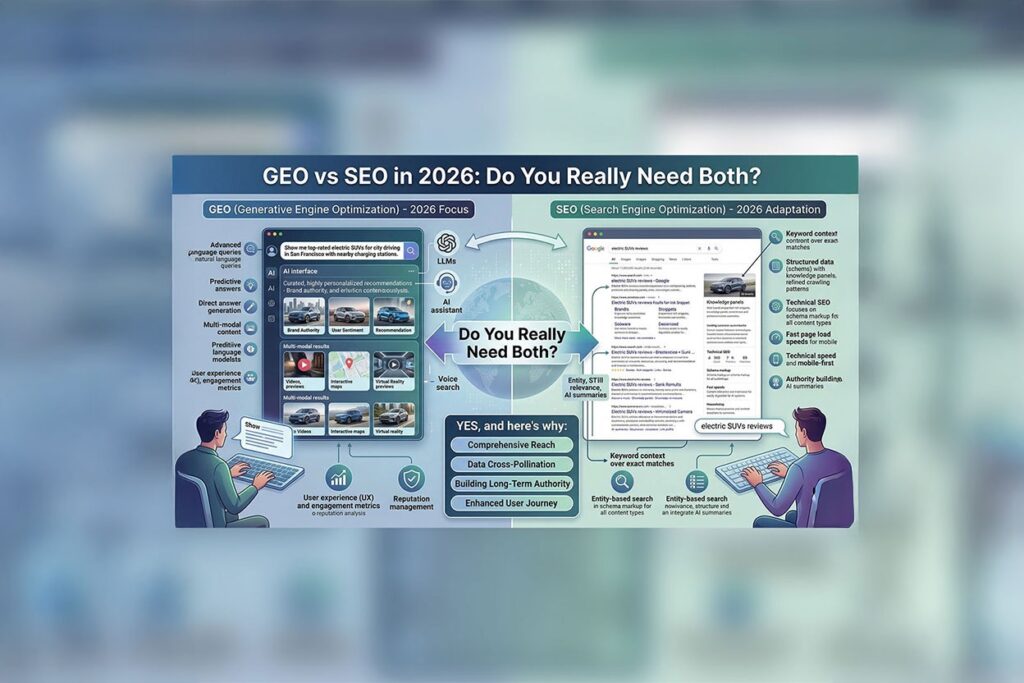
For more than 20 years, SEO has been the backbone of online visibility. Brands consistently published blog posts, built backlinks, and optimized pages to win that coveted first-page spot on Google. If you wanted organic traffic, SEO was non‑negotiable.
However, the way individuals search is rapidly evolving.
Instead of only “Googling” their questions, users are now turning to AI tools like ChatGPT, Perplexity, and Google’s AI Overviews for direct, conversational answers. They don’t always click through 10 blue links anymore—they expect an instant, summarized response. That shift is quietly rewriting the rules of search and discoverability.
This is where GEO—Generative Engine Optimization—comes in.
GEO is the practice of shaping your content so that AI systems can easily understand it, trust it, and choose it as a source when generating answers. While SEO helps you rank in traditional search results, GEO helps you get quoted, cited, and referenced inside AI-generated responses. In a world where more queries are being answered by AI, brands that adapt their content for both search engines and generative engines will be the ones that remain visible, relevant, and competitive.
Therefore, “SEO or GEO” isn’t the true question.
It’s: How do you use both so your brand shows up in Google and in AI-generated answers?”
Should we focus on SEO, GEO, or both?
In this article, we’ll break down GEO vs SEO in simple terms, explain how they differ, and help you decide which strategy makes the most sense for your business in 2026 and beyond.
GEO vs SEO: A Simple Comparison
Generative Engine Optimization (GEO) works differently from traditional SEO. Instead of just trying to rank higher on search engines, GEO is about making your content so clear, helpful, and trustworthy that AI tools like ChatGPT, Perplexity AI, and Google AI Overviews can easily understand it and feel confident using it in their answers.
Example: For instance, if an AI tool is asked, “What is GEO?” and your website explains it in a simple, clear way, the AI is more likely to use your content as one of its sources when giving a response.
Search Engine Optimization (SEO)
SEO is all about making your website easier to find on search engines like Google, Microsoft Bing, and Yahoo. When your site is well-optimized, search engines understand it better and are more likely to show it to people who are looking for what you offer.
It involves things like:
“SEO usually involves things like:
- Improving your content so it clearly answers what people are actually searching for.
- Fixing technical issues so your site loads quickly and works smoothly on mobile and desktop.
- Earning quality backlinks so search engines see your site as trustworthy and authoritative. ”
Example:
Imagine someone types “best pizza in Delhi” into Google. If a pizza shop has done good SEO, its website has a much better chance of appearing near the top of the search results, bringing it more visitors without paying for ads.
SEO helps you rank in search results. GEO simplifies quotations in AI responses.
How Does GEO Impact SEO?
The relationship between GEO and SEO is not competitive; it’s complementary.
To understand how GEO Impact SEO works, consider how modern search works today.
Search engines are increasingly integrating AI-generated summaries, conversational responses, and featured insights directly within search results.
This means:
- It needs to be clearly structured (with headings, lists, and short paragraphs) so AI systems can quickly understand it.
- It needs strong trust signals—like expert authorship, citations, and accurate data—so AI models feel confident using it.
SEO already pushes you to do many of these things.
GEO simply goes one step further by focusing on:
- Contextual clarity: making sure your content clearly answers specific questions users ask.
- Expert credibility: showing who is behind the advice and why they’re qualified.
- Structured information: using headings, FAQs, and schemas so AI can easily ‘read’ your page.
- Topic authority: publishing multiple, connected pieces around the same topic so you’re seen as a go-to source.
If SEO helps search engines find and rank your content, GEO helps AI systems understand and use your content in their answers.”
Is SEO Replaced by GEO?
“Is GEO going to replace SEO?” is one of the most common queries asked by marketers.’
The answer is no.
SEO is still the foundation of organic traffic. People still search on Google, and ranking there still matters.
GEO doesn’t replace SEO—it layers on top of it.
Think of it this way:
- SEO = visibility in search results
- GEO = visibility inside AI-generated answers
In the next few years, the brands that win will be the ones that invest in both: they’ll show up when people search on Google and when they ask AI tools for advice.
.
How to Measure GEO Success:
Traditional SEO focuses on metrics like keyword rankings, organic traffic, backlinks, and click-through rates. But with Generative Engine Optimization (GEO), the way we measure visibility is changing.
5 Simple Ways to Measure GEO Success
- AI Citations – Check how often AI tools mention or use your content in their answers.
Example: You ask an AI tool, “What is GEO in digital marketing?” and it takes an explanation or definition straight from your blog. That’s a clear sign your content is being treated as a source. - Brand Mentions – See how frequently your brand name appears in AI-generated responses.
For instance, even if the user never clicks on a link, it is still a useful brand mention when someone asks, “Which agencies can help with GEO and SEO strategy?” and the AI puts your brand name on its shortlist of suggestions.
- Authority Signals – Look for growth in your website’s credibility, such as expert mentions or trusted references. This could be other websites linking to your GEO content or industry blogs quoting your explanations.
- Knowledge Panel Visibility – Notice if your brand or content shows up in AI summaries or knowledge panels. When AI tools surface your company description, key pages, or founder details, it’s a sign they see your brand as a reliable source.
- Brand Awareness – Even if people don’t click your link, appearing in AI answers helps more people recognize and trust your brand. Over time, this can show up as more branded searches, direct traffic, and warmer leads.
In short, GEO success is about how visible and trustworthy your brand becomes in AI-powered search.
Latest FAQs
- What is the main difference between SEO and GEO?
SEO focuses on ranking content in traditional search engines, while GEO focuses on getting your content cited and referenced in AI-generated answers. - Is GEO replacing SEO?
No. GEO is not replacing SEO. Instead, GEO builds on top of SEO. Both work together to improve your overall online visibility—across search engines and AI tools. - Why is GEO important for the future of search?
More people are turning to AI platforms like ChatGPT, Perplexity, and Google’s AI Overviews for direct answers instead of clicking through multiple search results. GEO helps ensure your brand is visible inside those AI-generated responses. - Can businesses use SEO and GEO together?
Yes. In fact, they work best together. SEO helps your content rank in search results, while GEO helps your content get cited in AI-generated answers—so you can reach audiences through both search engines and AI tools.
Conclusion
In 2026 and beyond, GEO and SEO are no longer competing priorities but complementary strategies for sustainable visibility. SEO remains essential for ranking in traditional search results, while GEO ensures your expertise is surfaced inside AI-generated answers. By creating clear, structured, and trustworthy content, strengthening your technical SEO, and building topical authority, you position your brand to be found on Google and cited by AI tools alike. Businesses that invest in both will not only attract more organic traffic but also earn greater trust, recognition, and conversions across the evolving search landscape.